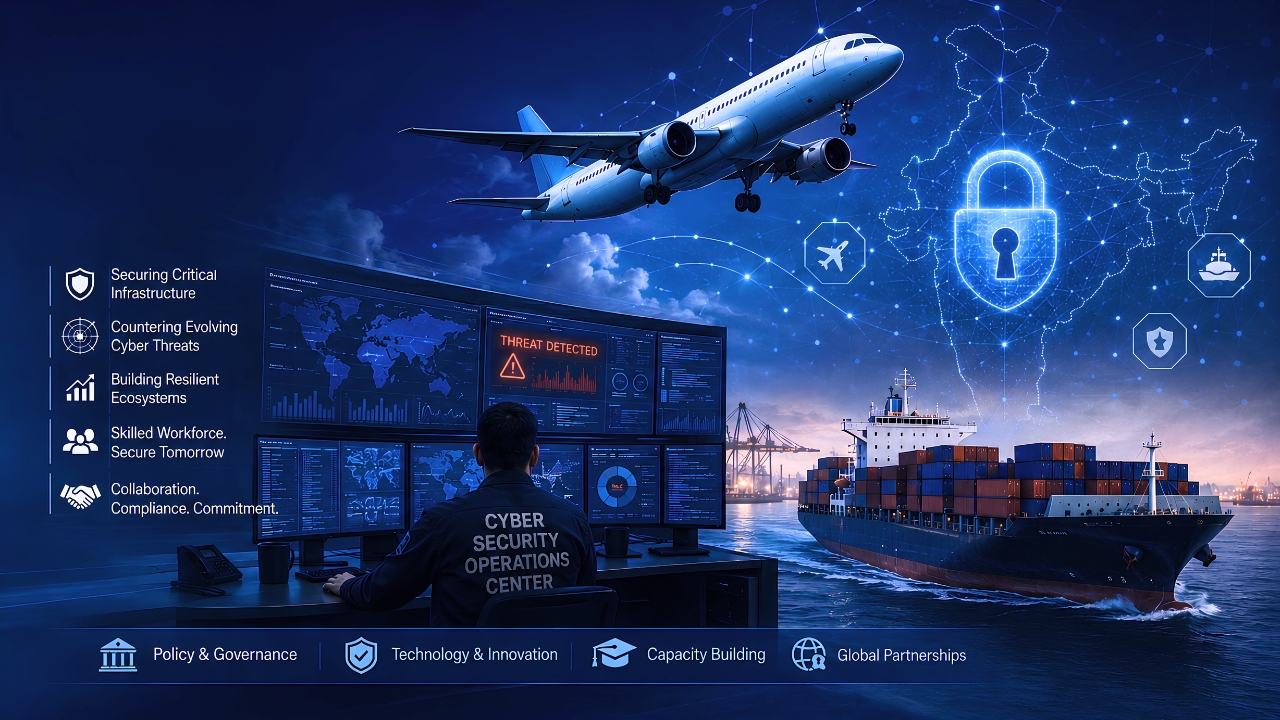
India’s economic growth is heavily propelled by its critical trade routes, transportation infrastructure, and transit hubs. The skies are busier than ever, with domestic air traffic scaling new heights and megaprojects like the Navi Mumbai International Airport coming online. Meanwhile, India’s 7,500-kilometre coastline, anchored by 12 major ports and a push to add 1,000 ships to its merchant fleet over the next decade, acts as the primary economic gateway for international trade. However, as Admiral DK Tripathi, Chief of Naval Staff, aptly put it, modern cyberattacks are no longer just threats to computer networks; they are “attacks on the arteries of the Indian economy.”
As both sectors transition toward hyper-connectivity, automated workflows, and artificial intelligence, the boundaries between the physical and digital worlds have dissolved. Protecting India’s critical transportation infrastructure requires an entirely new approach to cybersecurity resilience and cyber risk management.
The Convergence Danger: Where IT Meets OT
Historically, aviation and maritime cybersecurity focused on protecting Information Technology systems, such as passenger ticketing, emails, and manifest databases.
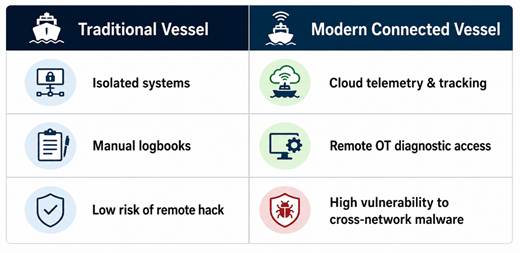
Today, the real danger lies in the convergence of IT with Operational Technology, creating expanded attack surfaces across critical infrastructure environments. OT comprises physical hardware and software that controls everything from an aircraft’s Flight Management System to a container ship’s ballast controls or a port’s automated gantry cranes.
When these once-isolated operational systems are hooked up to the internet for real-time telemetry and remote support, they become vulnerable to cyberattacks, ransomware campaigns, and nation-state threat actors.
Aviation Cybersecurity: Defending India’s Cloud-Connected Aviation Ecosystem
India’s aviation cybersecurity market is rapidly scaling, expected to surpass $280 million by the mid-2030s. As airports and airlines digitalize to handle massive passenger volumes, the threat landscape is expanding across three distinct fronts:
1. The Zero Trust Takeover
Traditional “perimeter-based” network security (relying on basic firewalls) is dead. Indian aviation entities are rapidly shifting toward a Zero Trust Security Architecture. Because airport ecosystems are heavily reliant on third-party vendors (ground handling, catering, biometrics, baggage logistics), networks are being strictly segmented. Every user, device, and application must continuously verify its identity before gaining access to critical flight or passenger databases.
2. AI vs. AI at the Airport Security Operations Center
Threat actors are increasingly using automated AI tools to execute fast-paced ransomware attacks and data theft. To counter this, Indian aviation hubs are integrating AI-driven Security Information and Event Management (SIEM) and threat detection systems. These platforms act as digital immune systems, sniffing out network anomalies and isolating suspected breaches in milliseconds before they can ground a fleet.
3. Data Privacy and the DPDP Act
With the strict enforcement of India’s Digital Personal Data Protection Act, airlines and airport operators face severe financial and legal penalties if passenger data, including facial recognition data used in DigiYatra, is compromised. Data protection is no longer just an IT compliance checklist; it is now a core pillar of data governance, privacy compliance, and enterprise cyber resilience.
Maritime Cybersecurity: Securing the Indian Ocean Arteries
The maritime domain is experiencing a massive wake-up call. Driven by international mandates like the International Maritime Organization cyber risk requirements, India’s maritime cybersecurity sector is seeing an unprecedented double-digit growth rate.
1. The Threat of “Cyber Piracy”
In the Indian Ocean Region (IOR), traditional maritime piracy has evolved into digital warfare. Attackers are no longer just boarding vessels with weapons; they are targeting shipboard networks. Incidents of unauthorized access to an unsegmented ECDIS (Electronic Chart Display and Information System) can alter a ship’s course without the bridge crew realizing it, or spoof AIS (Automatic Identification System) data to turn a massive cargo carrier into a “ghost ship” on tracking screens.
2. Port Automation and Ransomware Vulnerabilities
Indian ports handle over 800 million tons of cargo annually, increasingly utilizing automated IoT sensors and smart logistics networks. However, a single ransomware infection on a third-party cargo tracking software can paralyze an entire terminal through supply chain cyberattacks and ransomware disruptions—causing massive container backlogs, delayed supply chains, and millions of dollars in losses.
3. On-Premises Resilience for Fleets
Unlike shoreside businesses, a ship at sea cannot rely continuously on cloud-based security fixes due to spotty satellite links. The future of Indian maritime cyber defense leans heavily on on-premises, hardened network solutions installed directly on vessels, allowing ship captains and engineers to isolate infected OT networks independently while out at sea.
India’s Unified Blueprint for Resilient Transit
To ensure these critical pathways remain secure, India is moving away from reactive firefighting and toward cyber resilience and infrastructure security readiness:
- Public-Private Collaborations: Driven by agencies like CERT-In, the Indian Navy, and the Directorate General of Shipping, regular cross-sector cyber drills and workshops ensure that maritime and aviation professionals are trained in digital incident response.
- The Quad and Regional Alliances: Under multilateral initiatives like the Quad, India is championing information-sharing networks and building robust digital forensics capabilities to counter state-sponsored cyber espionage across the Indo-Pacific.
- Strict Regulatory Accountability: From the Directorate General of Civil Aviation (DGCA) implementing stricter software compliance checks on aircraft to ports hardening their critical infrastructure frameworks, policy is finally keeping pace with technological shifts.
Conclusion
The future of Indian aviation and maritime infrastructure cannot exist without an ironclad digital shield. As India charts its course to become a dominant global economic superpower, its safety will depend on its ability to protect the software guiding its planes and the networks steering its ships. True resilience will come from moving past paperwork compliance and embedding cybersecurity, cyber resilience, and operational security directly into the operational DNA of every pilot, mariner, and port operator.