

DPDP Act vs GDPR: 8 Key Differences Businesses Must Know

Summarize this blog with :
The Digital Personal Data Protection (DPDP) Act, 2023 and the General Data Protection Regulation (GDPR) share a common goal: protecting individuals' personal data. However, they differ in how they regulate data processing, consent, individual rights, children's data, penalties and cross-border transfers. This article explores seven key differences between India's DPDP Act and Europe's GDPR, helping businesses understand their obligations and prepare for data protection compliance across both jurisdictions.
DPDP Act vs GDPR: Two Privacy Laws. Different Compliance Requirements.
India Built Its Own Data Protection Framework. How Does It Compare with GDPR?
When India's Digital Personal Data Protection Act, 2023 (DPDP Act) was introduced, comparisons with Europe's General Data Protection Regulation (GDPR) were inevitable. Both frameworks aim to protect individuals' personal data while establishing clear responsibilities for organisations that collect, use and process it.
Many organisations assume that GDPR compliance automatically prepares them for India's DPDP Act. Unfortunately, that assumption can create significant compliance gaps. A multinational company may have mature GDPR controls in place yet still fail key DPDP requirements around consent management, children's data, lawful processing grounds, and Data Principal rights, exposing itself to penalties of up to ₹250 crore. This article highlights the seven most important differences every business should understand before relying on GDPR compliance as a proxy for DPDP readiness.
However, the similarities only go so far.
The DPDP Act and GDPR adopt different approaches to data protection. They differ in the types of information they cover, the legal grounds for processing personal data, individual rights, children's privacy, regulatory oversight and penalties for non-compliance.
For businesses operating in India, Europe or both markets, understanding these differences is important. A compliance framework designed around GDPR requirements may provide a useful starting point, but it does not automatically meet India's DPDP requirements.
Let's look at eight key differences between the DPDP Act and GDPR and what they mean for businesses.
1. Scope of Data Protection: Digital Data vs Digital and Physical Records
A key difference between the DPDP Act and GDPR is the scope of personal data they cover.
Under GDPR:
GDPR applies to personal data processed through automated means, as well as non-automated personal data that forms part of, or is intended to form part of, a structured filing system.
This means its scope extends beyond digital databases to certain physical records, provided they meet the filing-system requirement.
Under the DPDP Act:
The DPDP Act mainly applies to digital personal data. This includes information collected directly in digital form and personal data initially collected in physical form but subsequently converted into digital format.
Physical records that remain entirely offline and are not digitised generally fall outside the Act's scope.
What this means for businesses:
Organisations in India must identify where personal data is collected, stored and processed, including information held in digital systems and physical records that may later be digitised.
For multinational organisations, the difference becomes particularly relevant when managing customer records, employee information and other personal data across jurisdictions
2. Legal Grounds for Processing: Six Under GDPR vs Two Under DPDP
Another key difference between the two data protection laws lies in their legal grounds for processing personal data.
Under GDPR:
GDPR identifies six lawful grounds for processing personal data:
Consent.
Performance of a contract.
Compliance with a legal obligation.
Protection of vital interests.
Processing necessary for a task carried out in the public interest or the exercise of official authority.
Processing based on the legitimate interests of the organisation or a third party, subject to applicable conditions.
This gives organisations different legal grounds for processing information, depending on the purpose and circumstances.
Under the DPDP Act:
The DPDP Act provides two grounds for processing personal data:
Consent: The individual must provide free, specific, informed, unconditional and unambiguous consent through a clear affirmative action.
Certain legitimate uses: Section 7 identifies specific circumstances in which personal data may be processed without obtaining consent. These include certain voluntary disclosures, state functions, legal obligations, medical emergencies and employment-related purposes, among other specified situations.
Unlike GDPR, the DPDP Act does not recognise a general legitimate interest’s ground.
What this means for businesses:
An organisation cannot automatically rely on the legitimate interest's basis available under GDPR when processing personal data in India.
Businesses must assess each processing activity against the grounds recognised under the DPDP Act. Where consent is required, they must ensure that it meets the Act's requirements and that individuals can withdraw it through an accessible process.
This makes reviewing existing consent mechanisms and data processing practices an important part of DPDP compliance
3. Sensitive Personal Data: Special Categories Under GDPR vs a Unified Standard
Under DPDP
Not all personal data carries the same level of privacy risk. Some information, such as health records, biometric identifiers and details about an individual's beliefs, requires particular care.
However, GDPR and the DPDP Act approach this differently.
Under GDPR:
GDPR classifies certain types of personal data as special categories of personal data. These include:
Racial or ethnic origin
Political opinions
Religious or philosophical beliefs
Trade union membership
Genetic data
Biometric data used for uniquely identifying an individual
Health data
Data concerning sex life
Sexual orientation
Processing these categories is generally prohibited unless an applicable exception under Article 9 is satisfied, in addition to an appropriate lawful basis under Article 6.
Under the DPDP Act:
The DPDP Act does not create a separate legal category for sensitive personal data. Instead, it applies a common set of statutory obligations to personal data, without introducing a separate consent framework based on data sensitivity.
However, this does not mean that organisations can treat every type of personal data as equally low risk.
The Central Government may designate certain organisations as Significant Data Fiduciaries (SDFs), taking into account factors such as the volume and sensitivity of personal data processed, risks to individuals' rights and potential impacts on India's sovereignty and integrity.
SDFs are subject to additional obligations.
What this means for businesses:
Organisations that already maintain separate controls for sensitive data under GDPR should not assume that India's unified framework removes the need for additional safeguards.
A risk-based approach to data classification, access management, security controls and privacy governance remains important, particularly for organisations handling financial, health, biometric and other high-impact personal information.
4. Children's Data: Different Age Thresholds and Protection Requirements
Children's personal data receives special attention under both frameworks. However, the age threshold and applicable requirements differ.
Under GDPR:
The default age for a child to independently consent to the processing of personal data in connection with information society services offered directly to them is 16 years.
EU Member States can lower this threshold to 13 years through national legislation.
Where a child is below the applicable age, parental or guardian authorisation is required when consent is the relevant legal basis for processing.
Under the DPDP Act:
The DPDP Act defines a child as an individual who has not completed 18 years of age.
Before processing a child's personal data, a Data Fiduciary must obtain verifiable consent from the parent or lawful guardian, subject to applicable statutory exemptions.
The Act also restricts processing that is likely to cause a detrimental effect on a child's well-being. It prohibits tracking or behavioural monitoring of children and targeted advertising directed at children, subject to exemptions that may be prescribed by the government.
What this means for businesses:
Businesses offering digital services, mobile applications, educational platforms and consumer-facing websites must review how they identify and protect underage users.
A parental consent mechanism designed around GDPR's age threshold may not be sufficient for the Indian market.
Organisations should assess age-verification processes, parental consent mechanisms and their practices relating to behavioural monitoring and targeted advertising.
5. Individual Rights: Broader Rights Under GDPR vs Five Statutory Rights Under DPDP
Giving individuals greater control over their personal data is a central objective of both frameworks. However, the rights available under each law are different.
Under GDPR:
Individuals have a broad set of rights, including:
Right to be informed about data processing
Right of access to personal data
Right to rectification of inaccurate data
Right to erasure, also known as the right, to be forgotten
Right to restrict processing
Right to data portability
Right to object to certain processing activities
Rights relating to automated decision-making and profiling
Right to withdraw consent where consent is the legal basis for processing.
GDPR also provides rights to lodge complaints with supervisory authorities and seek judicial remedies.
Under the DPDP Act:
The DPDP Act establishes five key statutory rights for Data Principals:
Right to access information: Individuals can request a summary of their personal data being processed and information about certain related disclosures.
Right to correction and erasure: Individuals can request corrections, completion, updating or erasure of their personal data, subject to applicable legal requirements.
Right to grievance redressal: Individuals can seek resolution of their grievances through the Data Fiduciary's established mechanism.
Right to nominate: Individuals can nominate another person to exercise their rights in the event of their death or incapacity.
Right to withdraw consent: Individuals can withdraw previously given consent, subject to the applicable provisions of the Act.
The right to nominate is a distinctive feature of India's DPDP framework and does not have a direct equivalent in GDPR.
What this means for businesses:
Organisations operating in both jurisdictions should not assume that a single data subject rights management process will satisfy both laws.
Their privacy processes should account for the specific rights recognised under each framework, including how requests are received, verified, tracked and resolved.
6. Cross-Border Transfer
GDPR follows a "transfer only if permitted" model, whereas the DPDP Act follows a "transfer unless restricted" model.
Under GDPR:
Restrictive approach, personal data can be transferred outside the European Economic Area (EEA) only if adequate safeguards are in place.
Requires an adequacy decision, Standard Contractual Clauses (SCCs), Binding Corporate Rules (BCRs), approved codes of conduct, or other recognised safeguards.
Ensures the destination country provides a level of data protection essentially equivalent to that of the EU.
Compliance burden is high; organisations must assess transfer risks and implement contractual and technical safeguards.
Unlawful transfers can result in significant penalties and regulatory investigations.
Under the DPDP Act:
Permissive approach. Personal data may be transferred outside India unless the Central Government specifically restricts transfers to certain countries or territories.
No equivalent transfer mechanisms currently prescribed. Transfers are generally allowed except to restricted jurisdictions notified by the Government.
Focuses on Government oversight and strategic restrictions rather than requiring equivalent privacy protections in the destination country.
Compliance burden is comparatively lower; organisations mainly need to monitor government notifications regarding restricted countries and comply with sector-specific regulations.
Transfers to prohibited jurisdictions or in violation of future government restrictions may attract penalties under the DPDP Act.
What This Means for Businesses
Organisations operating globally often assume that if their data transfers comply with GDPR requirements, they will automatically satisfy Indian requirements. However, the two regimes take fundamentally different approaches.
Under GDPR, businesses must establish a specific legal transfer mechanism such as Standard Contractual Clauses (SCCs) before transferring personal data outside the EU. In contrast, the DPDP Act currently permits cross-border transfers by default, except where the Government may notify prohibited jurisdictions.
7. Penalties: Turnover-Based Fines Under GDPR vs Fixed Maximums Under DPDP
Financial penalties are an important part of regulatory enforcement. Both frameworks provide significant consequences for non-compliance, but their penalty structures differ.
Under GDPR:
GDPR establishes two levels of administrative fines, depending on the nature of the infringement.
The maximum penalties can reach:
Up to €10 million or 2% of the organisation's total worldwide annual turnover of the preceding financial year, whichever is higher, for certain infringements.
Up to €20 million or 4% of the organisation's total worldwide annual turnover of the preceding financial year, whichever is higher, for more serious infringements.
The applicable supervisory authority considers factors such as the nature, severity and duration of the infringement when determining the penalty.
Under the DPDP Act:
The DPDP Act follows a fixed maximum penalty structure, with amounts specified in its Schedule.
The maximum penalties include:
Penalties of up to ₹250 crore for failing to implement reasonable security safeguards to prevent personal data breaches.
Up to ₹200 crore for failure to notify the Data Protection Board and affected individuals about a personal data breach as required.
Up to ₹200 crore for violations of additional obligations relating to children's data.
Up to ₹150 crore for non-compliance with additional obligations applicable to Significant Data Fiduciaries.
Up to ₹50 crore for other violations of the Act or its Rules.
These are maximum statutory limits, not automatic fines. The Data Protection Board of India determines the appropriate penalty after an inquiry, considering factors such as the seriousness, duration and repetitive nature of the breach, mitigation efforts and proportionality.
What this means for businesses:
While GDPR links certain penalties to global annual turnover, the DPDP Act specifies maximum monetary amounts for different categories of violations.
Neither framework should be viewed as less demanding simply because its penalty calculation works differently.
For organisations, the practical priority should be preventing violations through effective security safeguards, documented privacy processes, timely breach response and ongoing compliance monitoring.
8. Consent Managers: A Distinctive Feature of India's DPDP Framework
Consent management is an important part of both data protection frameworks, but India's DPDP Act introduces a distinctive institutional mechanism.
Under GDPR:
GDPR requires organisations to obtain and manage valid consent wherever consent is the applicable legal basis for processing.
Businesses often use Consent Management Platforms (CMPs) to record consent preferences, manage permissions and facilitate withdrawal.
However, GDPR does not establish a direct equivalent of India's registered Consent Manager framework.
Under the DPDP Act:
The DPDP Act introduces the concept of a Consent Manager.
A Consent Manager is an entity registered with the Data Protection Board of India that acts as a single point of contact, enabling a Data Principal to give, manage, review and withdraw consent through an accessible, transparent and interoperable platform.
The DPDP Rules, 2025 specify the registration conditions and obligations applicable to Consent Managers under Rule 4.
Importantly, Rule 4 came into force on 13 November 2026, one year after publication of the Rules.
What this means for businesses:
Consent Managers introduce an additional layer to India's evolving consent management ecosystem.
Organisations should understand how the framework operates and assess whether their consent infrastructure can support transparent, accessible and interoperable consent management.
Although the introduction of Consent Managers does not mean every organisation must immediately integrate with one, businesses should consider the implications while planning their long-term DPDP compliance strategy.
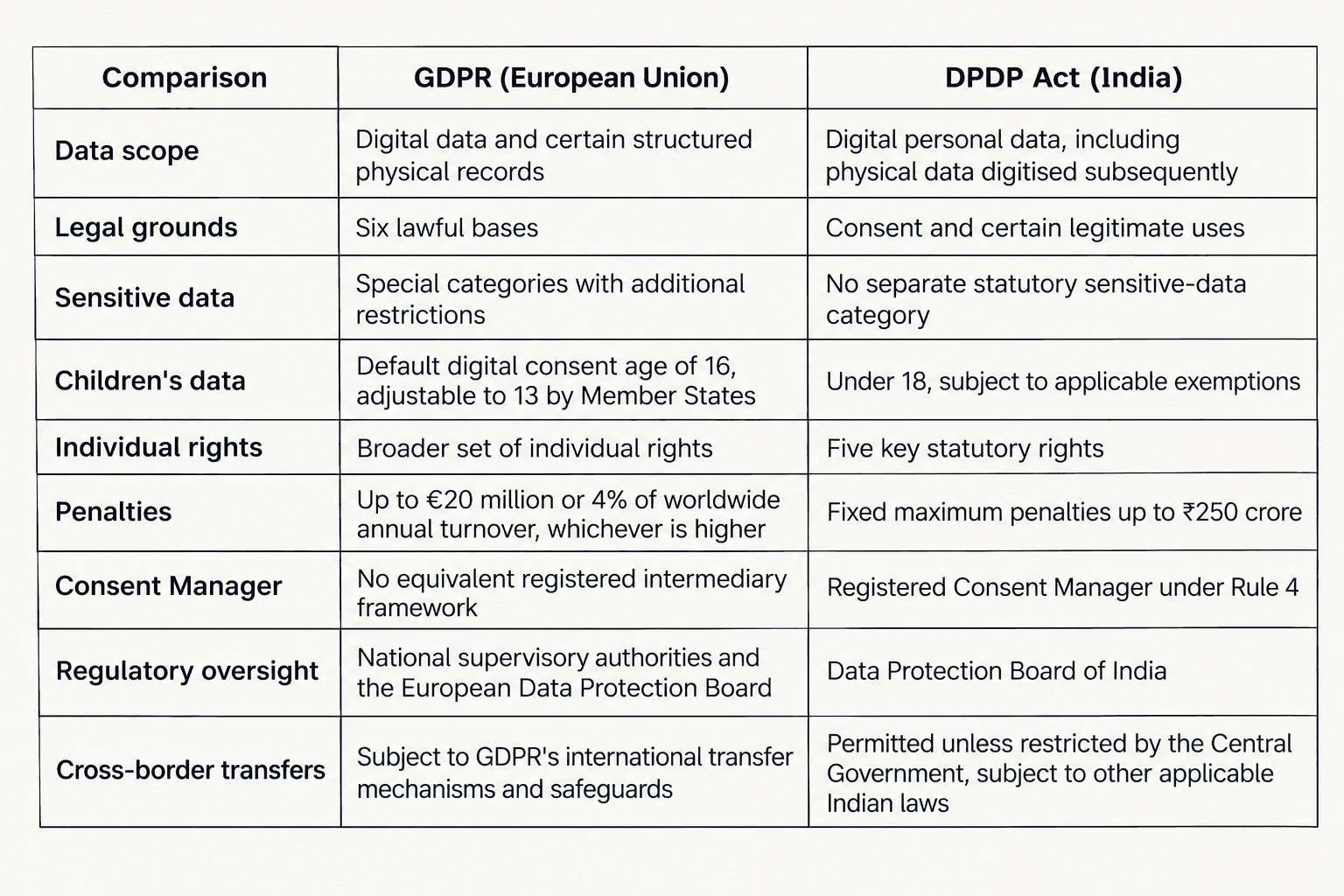
At a Glance: DPDP Act vs GDPR
The following table summarises the seven major differences between India's DPDP Act and Europe's GDPR.
Does GDPR Compliance Automatically Mean DPDP Compliance?
Not necessarily.
A well-established GDPR compliance programme can give organisations a strong starting point when preparing for India's DPDP Act. Several foundational practices are relevant to both frameworks, including:
Maintaining a record of personal data and processing activities.
Establishing appropriate security safeguards.
Reviewing third-party and vendor data processing arrangements.
Maintaining incident response and breach management processes.
Documenting privacy policies and internal procedures.
Establishing mechanisms for handling individual requests.
However, certain requirements need to be assessed specifically against India's legal framework.
These include the consent-first approach, the absence of a general legitimate interests ground, the 18-year age threshold for children, the right to nominate, the Consent Manager framework and additional obligations applicable to Significant Data Fiduciaries.
Organisations must also account for the DPDP Rules, 2025, including the prescribed requirements for notices, security safeguards, breach notifications, data retention and other operational processes.
In other words, GDPR compliance can provide a foundation, but businesses must conduct an India-specific assessment before concluding that their existing privacy programme meets DPDP requirements.
Preparing for India's Evolving Data Protection Requirements
Data protection compliance is not simply about having a privacy policy or obtaining consent through a website. It requires organisations to understand how personal data moves through their business, who has access to it, why it is processed and how it is protected throughout its lifecycle.
With the DPDP Act, 2023 and the DPDP Rules, 2025 establishing India's data protection framework, businesses should use the transition period to review existing practices, identify compliance gaps and strengthen their privacy governance.
As organisations work towards aligning their data protection practices with India's evolving regulatory requirements, 63SATS Cybertech supports businesses in assessing their privacy posture, identifying gaps and strengthening their approach to data protection and cybersecurity.
The objective is not just to meet regulatory requirements, but to build responsible data practices that support trust, accountability and long-term digital resilience.
FAQs
1. What is the difference between the DPDP Act and GDPR?
The DPDP Act is India's data protection law governing digital personal data, while GDPR regulates personal data processing across the European Union and European Economic Area. They differ in their scope, lawful grounds for processing, individual rights, children's data requirements, penalties and cross-border transfer rules.
2. Does GDPR compliance mean an organisation is automatically DPDP compliant?
No. GDPR compliance provides a useful foundation, but it does not automatically satisfy the DPDP Act. Organisations must address India-specific requirements, including consent management, the 18-year age threshold for children, the right to nominate and the absence of a general legitimate interests basis.
3. What are the penalties for non-compliance under the DPDP Act?
The DPDP Act provides for financial penalties of up to ₹250 crore for failure to implement reasonable security safeguards to prevent personal data breaches. Other violations carry different maximum penalties, including up to ₹200 crore for certain breach notification and children's data violations.
4. Does the DPDP Act allow cross-border data transfers?
Yes. The DPDP Act generally permits the transfer of personal data outside India unless the Central Government restricts transfers to specified countries or territories. Organisations must also comply with other applicable Indian laws and sector-specific requirements.
5. What are the key requirements for DPDP compliance?
Organisations should establish valid consent mechanisms, maintain accurate personal data inventories, issue compliant privacy notices, implement reasonable security safeguards, establish breach response procedures, enable Data Principal rights and review third-party data processing arrangements. Additional obligations may apply to Significant Data Fiduciaries.